The RD24 panel-mount connector (also commonly known as the RD24 power connector) is a robust and durable industrial circular connector widely used in industrial automation, new energy, and transportation sectors. It is renowned for its reliable screw-locking mechanism and high protection rating.
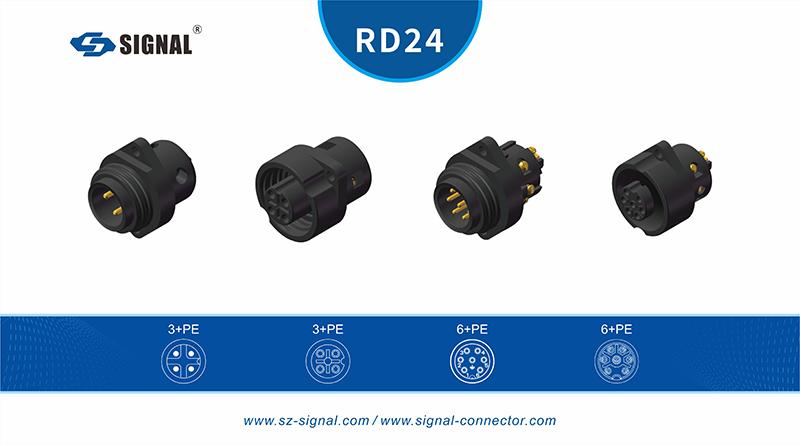
I. Advantages of SIGNAL RD24 Panel Connectors
1. Long Service Life
With over 100 mating cycles, it significantly reduces maintenance frequency and costs during long-term operation.
2. High Protection
The protection level reaches IP67/IP68. effectively preventing dust and water ingress, making it suitable for harsh environments.
3. Stable Connection
Using a standard RD24 threaded locking mechanism, it effectively prevents accidental loosening caused by mechanical movement or vibration.
4. High Current Capacity
RD24 panel connectors typically offer 4-pin (3+PE) or 7-pin (6+PE) versions. The 4-pin version has a maximum single-pin current of up to 16A and a voltage of up to 250V.
5. International Standard Certification
Generally certified by authoritative bodies such as UL, complying with industrial safety standards in major global markets.
II. Application Scenarios of SIGNAL RD24 Panel Connectors
Industrial Automation: Used for connections between sensors, actuators, controllers, and other equipment, ensuring stable system operation.
New Energy: In solar and wind power generation equipment, used to connect sensors, controllers, and power modules, ensuring stable power supply and data transmission in harsh environments.
Transportation: Used for connecting on-board electrical equipment in high-speed rail and other rail transit scenarios.
Medical Equipment: Some models can be used for power and signal connections in medical equipment, ensuring accurate data transmission and meeting the strict safety and reliability requirements of medical devices.