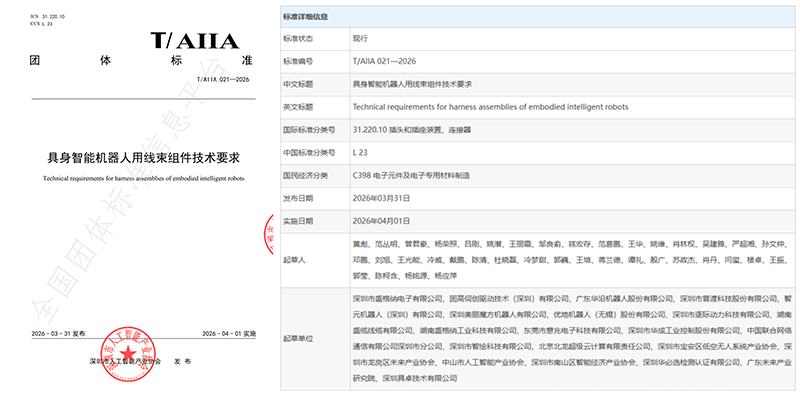
With the rapid advancement of the embodied intelligence industry, high-end intelligent equipment such as humanoid robots and quadrupedal robotic dogs are accelerating towards commercial mass production. To safeguard the healthy development of the industry, on April 1, 2026, the Shenzhen Artificial Intelligence Industry Association officially released and implemented the group standard "Technical Requirements for Wiring Harness Components for Embodied Intelligent Robots" (T/AIIA 021—2026). This standard is managed by the association and led by Shenzhen Shenggena Electronics Co., Ltd. The release of this standard marks the arrival of the first system-level, practical technical specification for "connectors and wiring harness components" in my country's embodied intelligent robot underlying hardware supply chain, effectively filling the standard gap in this sub-sector.
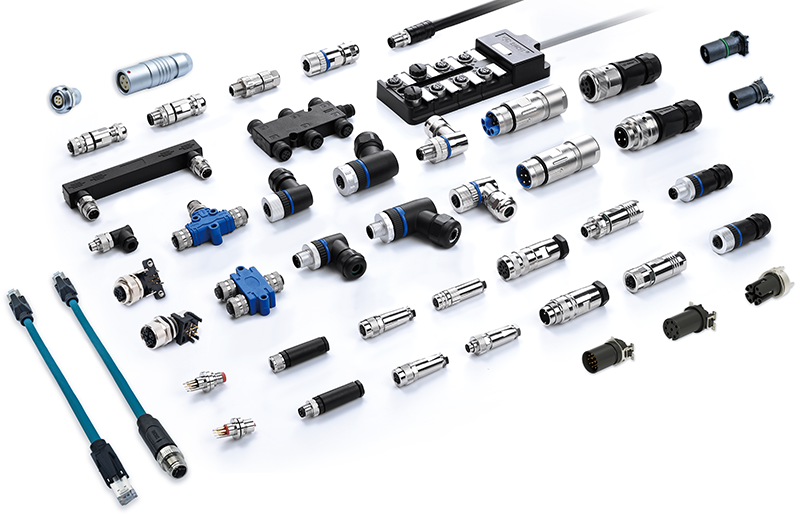
Connectors and cables are hailed as the "nerves and blood vessels" of robots, responsible for transmitting power and massive amounts of data between the control brain, sensory organs, and execution body. Unlike traditional industrial equipment, the joints of embodied intelligent robots often require three-dimensional, high-frequency complex movements, and the internal space is extremely limited. Traditional connectors are highly susceptible to fretting wear, signal interruption, and even mechanical breakage under such operating conditions, becoming a critical bottleneck in the integration and long-term operation of complete systems. Addressing this common industry pain point, this group standard integrates the evaluation systems of national and industry standards for wire harnesses from multiple fields. Starting from the actual working conditions of embodied intelligent robots, it scientifically standardizes the testing and evaluation system for connectors and wire harness components. The standard scientifically classifies and grades connectors based on the actual physical architecture of robots and specifically introduces stringent "microsecond-level" transient interruption monitoring and millions of cycles of "composite torsion" dynamic life assessment, establishing a solid industry benchmark for OEMs to accurately select connectors and design high-reliability systems for complex and extreme application scenarios.
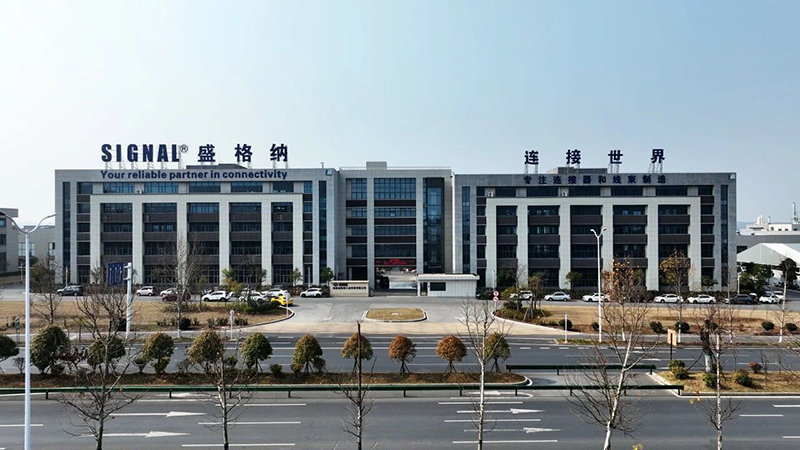
As the leading party in this group standard, Sengner Electronics has built strong industrial and R&D barriers since its establishment in 2009. Currently, Siegfried Electronics not only has a 40,000-square-meter modern, high-volume intelligent manufacturing base in Shenzhen and Zhuzhou, but also independently develops over 20,000 connector product specifications. Thanks to its superior quality, its products are exported to more than 60 countries worldwide, providing long-term, stable service to numerous Fortune 500 companies. To ensure the scientific rigor and precision of the quantitative indicators in this group standard, the stringent test parameters in the standard rely on Siegfried Electronics' high-standard internal testing platform, namely the Guangdong Provincial Laboratory. Utilizing its advanced testing equipment, such as high-precision image dimension measuring instruments and X-ray fluorescence coating thickness gauges, Siegfried Electronics provides measured data support for various core test methods.
We expect that the formal implementation of this standard will not only build a mutually trusting and interoperable technical benchmark for the upstream and downstream of the industry chain, but also effectively regulate and promote the technological upgrading of the domestic underlying hardware supply chain. In the future, Siegfried Electronics will lead with high standards and high quality, jointly building a prosperous ecosystem for the intelligent industry!