1. BNC Connector
The BNC connector is a common type of RF coaxial connector; the designation "BNC" stands for "Bayonet Neill-Concelman." It utilizes a bayonet-style locking mechanism, allowing for quick connection and disconnection. BNC connectors are typically used for lower-frequency applications—ranging from DC to 4 GHz—such as in test instrumentation and video surveillance systems.
2. N-type Connector
The N-type connector is a larger RF coaxial connector; the designation "N" stands for "Naval Connector." It features a threaded coupling mechanism and supports a broad frequency range, typically from DC up to 11 GHz or higher. N-type connectors are suitable for high-power applications, including broadcasting, communications equipment, and radar systems.
3. SMB Connector
The SMB connector is a smaller RF coaxial connector; the designation "SMB" stands for "SubMiniature version B." It employs a snap-on (push-fit) coupling mechanism, facilitating rapid connection and disconnection. SMB connectors are generally used for mid-to-high frequency applications—ranging from DC to 4 GHz—such as in communication systems and test equipment.
4. SMA Connector
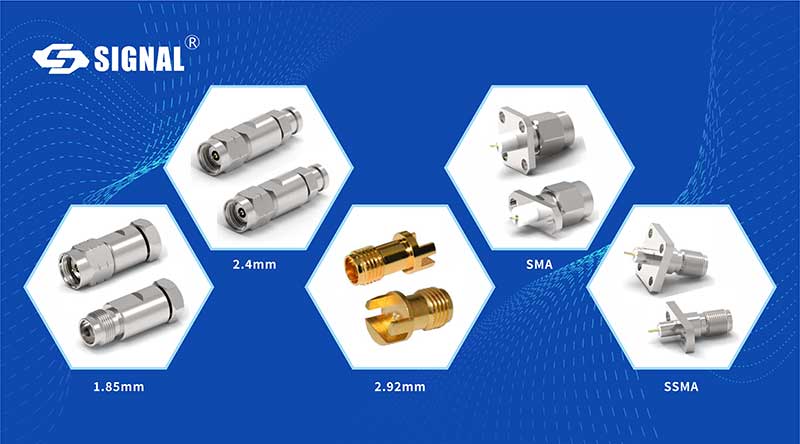
The SMA connector is a smaller RF coaxial connector; the designation "SMA" stands for "SubMiniature version A." It features a threaded coupling mechanism and typically operates across a frequency range from DC to 18 GHz. With its compact form factor and excellent electrical performance, the SMA connector is well-suited for high-frequency applications, including wireless communications, measurement equipment, and aerospace systems. 5. TNC Connector
The TNC connector is an improved version of the BNC connector; the designation "TNC" stands for "Threaded Neill-Concelman." It utilizes a threaded coupling mechanism, which provides a more secure and reliable connection. Typically suitable for frequency ranges from DC up to 11 GHz (or higher), the TNC connector serves as an upgrade to the BNC connector and is widely used in high-frequency, demanding RF (radio frequency) systems.
While these RF coaxial connectors differ in their designations and designs, they all play a vital role in RF applications. When selecting a connector, users should consider factors such as frequency range, coupling mechanism, and physical dimensions to ensure the chosen component meets the requirements of their specific application. These connectors are extensively used in fields including aerospace, instrumentation, and telecommunications, providing reliable solutions for the transmission and interconnection of RF signals.