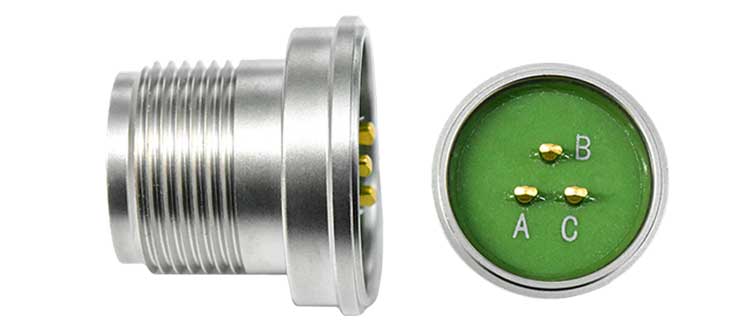
I. Key Features and Advantages
1. Core Hermetic Sealing Technology:
The essence of glass-to-metal sealed connectors lies in the sealing technology itself. By forming strong chemical bonds between molten glass and the metal surface at high temperatures, a dense, non-porous, and permanent seal is created—offering performance far superior to standard physical or adhesive seals.
2. Excellent High-Temperature Resistance:
As an inorganic non-metallic material with a high softening point, glass typically withstands operating temperatures ranging from -60°C to +350°C (or even wider). It emits no harmful substances at high temperatures, whereas plastic connectors may release volatile compounds and are prone to aging under similar conditions.
3. Superior Mechanical Strength:
The chemical bonding between the glass and the metal's oxide layer (formed during the molten state) is far stronger than the adhesion between plastic and metal. Consequently, these connectors can withstand significant tensile and torsional stresses, maintaining stability in environments subject to vibration and shock.
4. Stable Electrical Insulation:
Glass inherently possesses excellent insulating properties; its insulation resistance and dielectric strength meet rigorous design requirements while offering resistance to corrosion from various chemical substances.
II. Key Application Areas
Thanks to their outstanding performance, glass-to-metal sealed connectors are indispensable in the following fields:
1. Industrial Equipment:
Used in applications such as high-temperature furnaces and signal transmission for nuclear power instrumentation, where long-term, stable operation in high-temperature, high-pressure, or radiation-exposed environments is required.
2. Communication Equipment:
Utilized for signal transmission and insulation support in high-power RF power amplifier modules, such as those found in 5G base stations.
3. Aerospace: Used for engine sensors, external equipment connections, and similar applications; must withstand extreme temperatures, vibration, and vacuum environments.
4. Test and Measurement: Applications requiring high sealing integrity and stable electrical interfaces, such as vacuum chambers and high-voltage experimental setups.
5. Automotive Electronics: Particularly in high-voltage and high-temperature areas of new energy vehicles, such as battery management systems and motor controllers.