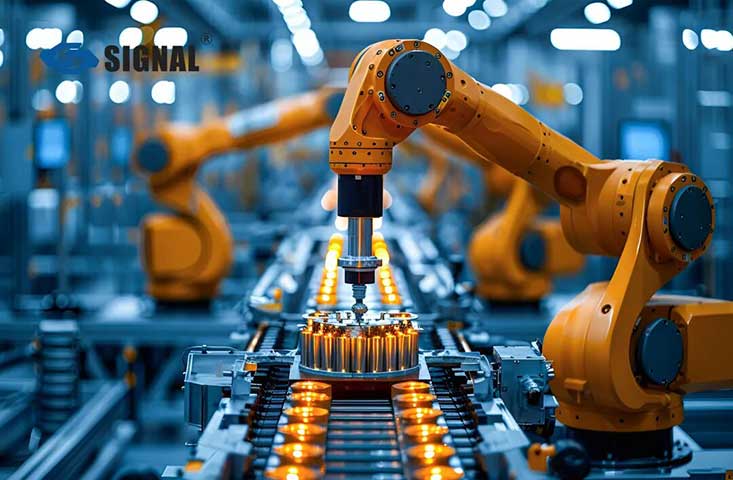
As the global manufacturing industry undergoes an intelligent transformation, robotic arms have become indispensable core components of modern factories. Whether in precision manufacturing or high-risk work environments, the application of robotic arms delivers significant benefits to enterprises.
I. What requirements must connectors for robotic arms meet?
As core equipment in intelligent manufacturing, robotic arms are characterized by high precision, high stability, and long-duration operation; consequently, the connectors used must possess specific technical attributes:
1. Resistance to bending (for cable carriers) and vibration
During operation, robotic arm joints undergo high-frequency twisting and reciprocating motion; connectors must withstand continuous vibration and mechanical stress.
2. Signal stability
Robotic arms require high-speed transmission of control signals and power; signal fluctuations can easily lead to positioning errors, operational anomalies, or even system alarms and shutdowns.
3. Adaptability to complex and harsh environments
Robotic arms often operate in workshops or warehouses, where they are inevitably exposed to oil, dust, moisture, and extreme temperatures. Connectors must offer robust protection to ensure reliable, stable, and safe operation in these demanding environments.
4. Compact size
Joint structures—such as the wrist and elbow—are compact, leaving very limited space for connector cabling.
II. SIGNAL M12 connectors meet robotic arm connectivity needs
SIGNAL M12 connectors have obtained professional certifications such as CE and TUV. With comprehensive product certifications, they are currently deployed in robotic arm applications, successfully meeting technical requirements for field use. Its key features are as follows:
1. High Flex and Vibration Resistance
The SIGNAL connector cable assembly features a minimum bending radius of ≤5 times the cable diameter. It has withstood millions of cable carrier cycles and over 500 cycles of ±180° torsion, far exceeding industry standards. Additionally, the threaded locking mechanism ensures vibration resistance and prevents loosening; this guarantees stable power and signal transmission—without lag or disconnection—even during high-speed operation and rapid pose changes of the robotic arm.
2. Lossless Signal and Stable Power
SIGNAL M12 connectors utilize a 360° full-shielding design to completely isolate electromagnetic interference. Precise transmission of control and sensor signals enables more accurate positioning and agile movement for the robotic arm.
3. High Protection and Exceptional Durability
With an IP67 (or higher) protection rating, SIGNAL connectors are waterproof, dustproof, and oil-resistant. They effectively withstand workshop dust, cutting fluids, and moisture, ensuring stable, all-weather operation.
4. Compact and Space-Saving
SIGNAL M12 connectors feature a standard compact design that fits perfectly into the tight spaces of robotic arm joints, allowing for neat cabling that does not interfere with the arm's range of motion.
5. Extensive Product Range
SIGNAL M12 connectors are available in a wide variety of configurations—including straight, angled, panel-mount, field-wireable, overmolded, and adapter types—fully meeting the growing demand for customized solutions in the robotics industry.
6. Additional Advantages
Standardization and Modularity: The standardized design of SIGNAL M12 connectors allows for universal use across different types of vehicles, thereby reducing production costs and inventory pressure. Meanwhile, the modular design facilitates rapid connector replacement and repair, enhancing vehicle maintainability and reliability.
Ease of Maintenance: SIGNAL M12 connectors feature a quick-connect/disconnect design that simplifies module replacement, repair, and upgrades for robotic arms, effectively reducing downtime.
Frequent robotic arm malfunctions often stem not from core component failures, but from the incorrect selection or improper use of connectors. Paying attention to this "small part" is key to ensuring stable operation, lowering maintenance costs, and boosting production efficiency.
If you are unsure which connector is right for your robotic arm, feel free to leave a comment below describing your application scenario (e.g., industry, robotic arm model, transmission requirements), and we will provide a precise recommendation!